
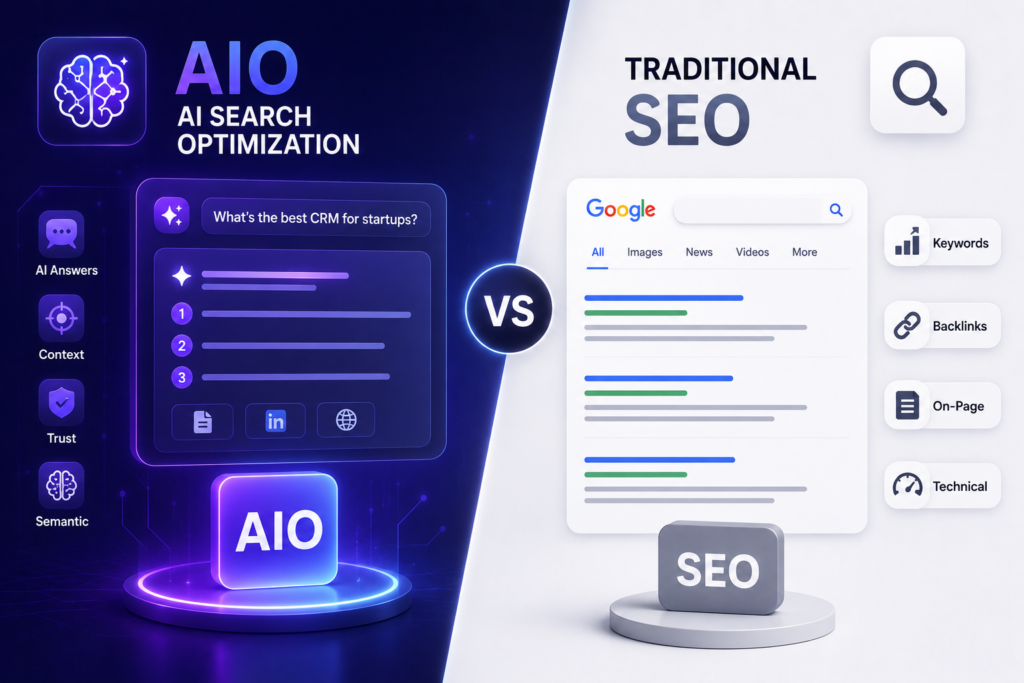
Why AIO Matters More Than Ever in 2026
AI search is rewriting the rules of visibility. Instead of showing users a list of links to click, AI-powered search engines like Google’s AI Overviews, Perplexity, and ChatGPT now synthesize answers directly from multiple sources.
The result? Click-through rates have dropped by 15.5% for queries that trigger AI summaries. But here’s the opportunity: if your content is cited inside that AI answer, you gain massive brand authority—even without a click.
💡 Key Stat: Over 50% of search interactions will occur within an AI environment by the end of 2026
How AI Search Differs from Traditional SEO
| Factor | Traditional SEO | AI Search Optimization (AIO) |
| Goal | Rank #1 in organic results | Be cited in AI-generated answers |
| Content Format | Keyword-optimized articles | Direct, extractable Q&A blocks |
| Success Metric | Clicks, rankings, traffic | Citations, mentions, brand visibility |
| User Intent | “Find information” | “Get an answer now” |
| Technical Focus | Backlinks, page speed | Structured data, semantic clarity |
🎯The 5 Pillars of AIO Success
1️⃣ Answer-First Content Structure
AI systems prioritize content that delivers clear, self-contained answers. Structure every section to:
- Start with a direct answer (1-2 sentences)
- Follow with supporting details, data, or examples
- End with a concise takeaway
✅ Example:
Q: What is AI Search Optimization?
A: AI Search Optimization (AIO) is the practice of structuring content to be cited, summarized, or referenced by AI-powered search engines like Google AI Overviews and Perplexity. Unlike traditional SEO, AIO focuses on semantic clarity and extractable insights rather than keyword density.
2️⃣ Semantic Richness Over Keyword Stuffing
AI models understand context, not just keywords. Use:
- Natural language variations of your target topic
- Related concepts and synonyms
- Question-based headings (“How does…”, “Why is…”, “What if…”)
🔍 Pro Tip: Use tools like Semrush Prompt Research to discover how real users phrase complex queries.
3️⃣ Structured Data & Schema Markup
While not guaranteed, schema types like FAQPage, HowTo, and Article may help AI systems identify and extract your content.
<script type="application/ld+json">
{
  "@context": "https://schema.org",
  "@type": "FAQPage",
  "mainEntity": [{
    "@type": "Question",
    "name": "What is AI Search Optimization?",
    "acceptedAnswer": {
      "@type": "Answer",
      "text": "AI Search Optimization (AIO) is the practice of structuring content to be cited by AI-powered search engines..."
    }
  }]
}
</script>
4️⃣ Multimodal Content Readiness
AI search increasingly blends text, images, and video. Optimize by:
- Adding descriptive alt text to all images
- Including transcripts for video/audio content
- Using captions that summarize visual context
📊 Data Point: Google Lens processes over 12 billion visual searches monthly.
5️⃣ Authority & Trust Signals
AI systems prioritize credible sources. Boost your E-E-A-T (Experience, Expertise, Authoritativeness, Trustworthiness) by:
- Citing reputable sources with links
- Displaying author credentials and bios
- Keeping statistics and data up to date
- Showing clear publication dates
🛠️ AIO Implementation Framework (90-Day Plan)
Phase 1: Audit & Foundation (Days 1-30)
- Run a technical SEO audit (crawlability, indexability)
- Identify pages already appearing in AI Overviews
- Map high-value queries to answer-first content templates
Phase 2: Content Optimization (Days 31-60)
- Rewrite key pages with direct Q&A structure
- Add schema markup to top 20 priority pages
- Create multimodal assets (infographics, short videos) with transcripts
Phase 3: Performance & Iteration (Days 61-90)
- Monitor citation frequency using AI visibility tools
- A/B test different answer formats
- Update underperforming content with fresh data
📈 Measuring AIO Success: Beyond Clicks
| Metric | Tool | AI Search Optimization (AIO) |
| Citation Frequency | Semrush AI Visibility Toolkit | Shows how often your brand is referenced in AI answers |
| Brand Mentions in AI | Brandwatch, Mention | Tracks unlinked brand visibility |
| AI-Driven Traffic | Google Analytics 4 (custom segments) | Isolates traffic from AI-referral sources |
| Query Coverage | Google Search Console | Identifies which queries trigger AI Overviews featuring your content |
✅ Quick AIO Checklist
- Lead each section with a direct, 1-2 sentence answer
- Use question-based headings matching natural queries
- Add FAQ or HowTo schema to priority pages
- Include alt text and transcripts for all media
- Cite reputable sources with clear attribution
- Keep statistics and publication dates current
- Monitor AI visibility with dedicated tools
FAQs
Does AIO replace traditional SEO?
No. AIO complements SEO. You still need technical optimization, quality content, and backlinks—but now you also optimize for AI extraction and citation.
How long does it take to see AIO results?
Most brands see increased citation frequency within 60-90 days of implementing answer-first content and structured data.
Can small businesses compete in AIO?
Absolutely. AIO rewards clarity and relevance over domain authority. A well-structured, niche-focused article can out-rank larger competitors in AI summaries.
What content formats perform best in AI search?
Q&A blocks, comparison tables, step-by-step guides, and data-driven insights with clear sourcing.
