
PhysicsGPT – AI Physics Solver to Visualize & Master Physics
Upload a problem, paste lab data, or ask a conceptual question. Get step-by-step derivations, interactive simulations, and real-world context that builds true understanding—not just formula memorization.
TRY FREE AI TOOLS
Why PhysicsGPT Changes How You Learn
Step-by-Step Derivations, Not Just Plug-and-Chug
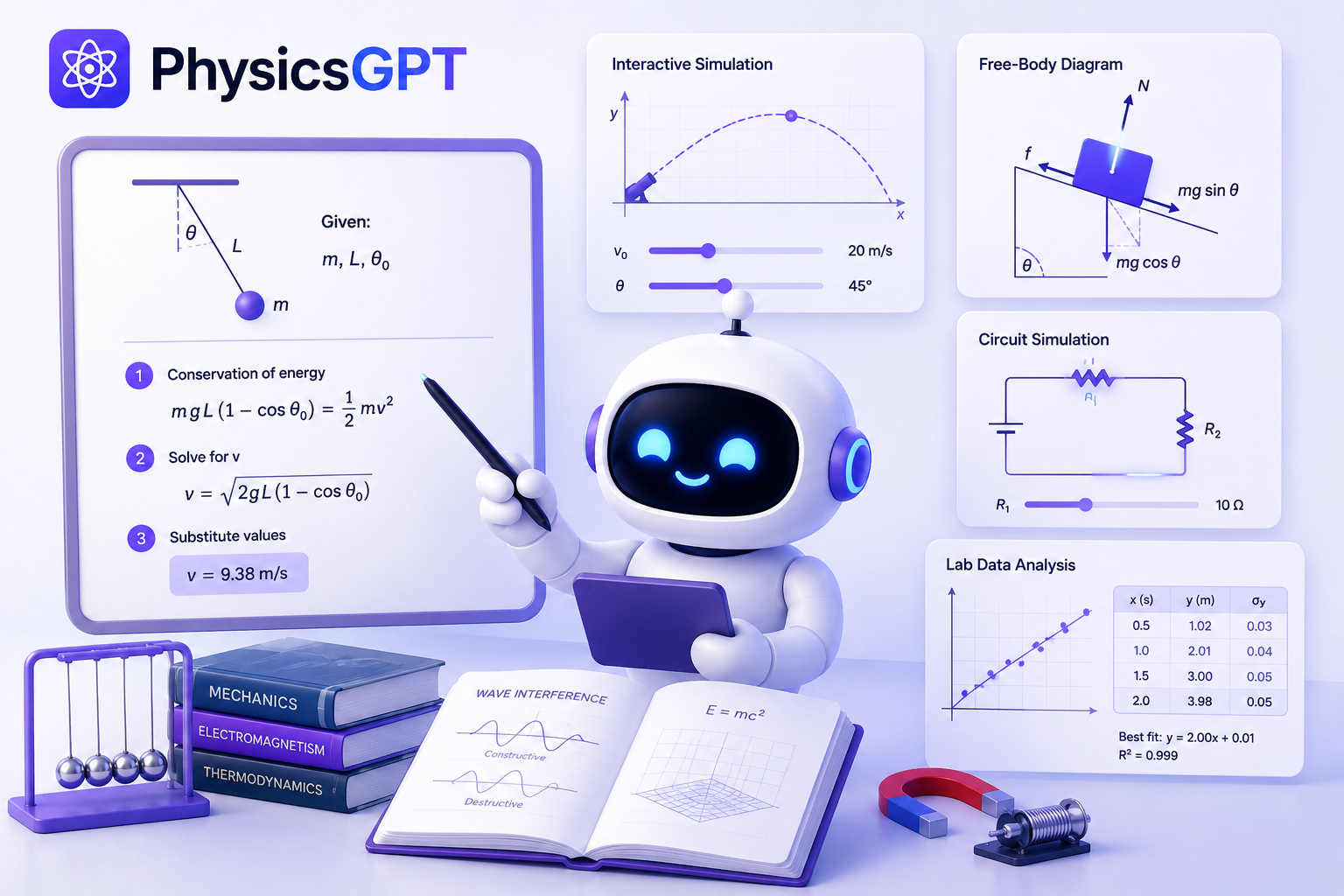
Interactive Diagrams & Simulations
Lab Data & Uncertainty Analysis
Concept Mapping & Prerequisite Tracking
Academic Integrity Modes
Privacy-First & Education-Compliant
How Physics GPT Works?
Input Your Problem – Type equations, paste LaTeX, upload handwritten photos, or drag in lab datasets. Supports kinematics, E&M, thermodynamics, optics, and modern physics notation.
AI Parses & Maps Physics Domains – Identifies core concepts, checks dimensional consistency, and selects the optimal problem-solving pathway (Newtonian, Lagrangian, circuit rules, wave models, etc.).
Receive Guided Solutions + Visualizations – Get structured steps, interactive diagrams, parameter sliders, and real-world context tags (e.g., “This models satellite orbital decay”).
Practice, Simulate & Export – Generate variant problems, tweak simulation variables, or export to PDF/Notion/Canvas with properly formatted units and significant figures.
Built for Every Physics Journey
🎓 High School & AP/IB Students
Master mechanics, waves, and electricity with visual breakdowns and exam-aligned practice sets.
🧑🔬 College & Engineering Majors
Tackle calculus-based physics, partial differential equations, and thermodynamic cycles with rigorous derivations.
👨🏫 Teachers & Lab Instructors
Create problem variants, interactive demos, grade lab reports, and track concept mastery.
🛠️ Makers & Hobbyists
Quickly model projectile trajectories, optimize circuit designs, or simulate thermal loads for DIY engineering projects.
Ready to Stop Memorizing and Start Understanding?
FAQs
Does PhysicsGPT just plug numbers into formulas?
No. PhysicsGPT prioritizes conceptual reasoning. Each solution explains the governing principles, shows variable isolation, checks dimensional consistency, and maps to real-world systems before computing a final value.
Can it handle calculus-based or advanced undergraduate physics?
Yes. Covers AP Physics through upper-division mechanics, electromagnetism, thermodynamics, optics, and introductory quantum/statistical physics. Supports symbolic derivation, partial differential setups, and numerical approximation methods.
Is PhysicsGPT safe for K-12 classrooms?
Fully COPPA and FERPA compliant. No student data is collected for advertising, profiling, or model training. School deployments include admin controls, data retention policies, and SSO/SAML integration.
Are uploaded problems or lab data stored?
Processed in-memory and permanently deleted post-session. Optional cloud sync is end-to-end encrypted and user-controlled. Enterprise/education plans support private data residency.
What input formats work best?
Typed text, LaTeX, image uploads (handwritten or textbook scans), voice-to-physics, and CSV lab data. Our vision engine accurately parses vectors, circuit symbols, waveforms, and Greek notation.
